Why do you blog?
I started writing my blog as a way to explain how my sight loss and Charles Bonnet Syndrome effects my life… it’s more for me than others.
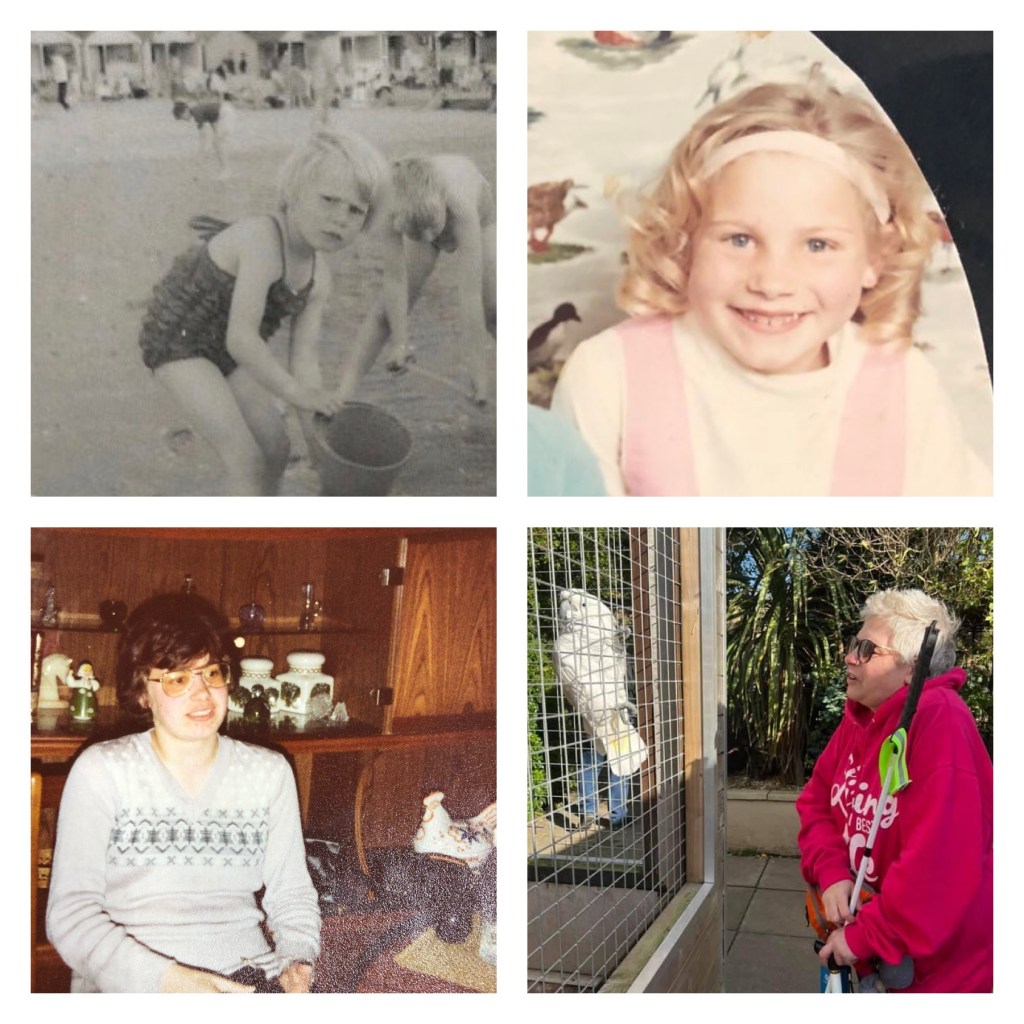
Life is always changing. The child in the black and white family photo on the beach (top left), whom from the frown on my face I suspect already found distant things fuzzy with myopia that would be corrected with specs, became the woman who was to become by medical definition blind (bottom right).
Like the majority of “lay people” I didn’t realise how sight, and therefore sight loss, was a complete spectrum from almost super sight (the person who seems to recognise a person a mile off) to absolute nothingness.
I didn’t realise that being blind could be perfect sight with a large percentage of the field of vision shrunk, as well as having perfect field of vision with an extremely short range of focus that cannot be corrected. I thought both those definitions were partially sighted and that only if a person couldn’t see anything at all that they were blind.
It certainly doesn’t help that Guide Dogs has this definition on their website “Total blindness means being unable to see anything, for example, not telling light from dark or having severely limited vision or field of vision.” This is the version that was updated in October 2022. A better definition of blindness would be made by stating it “is a spectrum from having severely limited sight and/ or a severely limited field of vision up to having no sight at all including not being able to tell light from dark.”
Here I am nearly 7 years after my sight loss was diagnosed facing the next “change”.
With my remaining sight being so restricted and my lamps etc at home being adjusted to give me the best light for my needs it took being at my daughter’s where she uses her overhead light for me to notice a large blind spot surrounded by an aura has developed in my “good” eye. It covers between about 25% (just the blind spot) to 33% (including the aura) of the top right of my field of vision. It’s most noticeable in pre dusk gloom, or under overhead lighting.
I’m not sure if it is caused by the scarring on the retina, damage on the optic nerve, or the cataract that has been forming that I’d already caused a blind spot in lowlight conditions; and to be honest it really doesn’t matter what the cause is I will adapt.
By writing blogposts like this I’m able to process the changes in my sight as well as document how I live my life now.
And hopefully I can give you an insight into how my sight loss isn’t a tragedy. And why accessibility is so important as it that lack which disables me not my sight loss.
Until next time.
 Was that a dinosaur? 2.0
Leave a comment